Built for Yesterday's Weather
Europe is failing in the heat it never prepared for. Asia is failing in the rain it built for — but not enough. The same climate stress, two entirely different civilisational crises. What this summer reveals about where to live, operate, and invest.

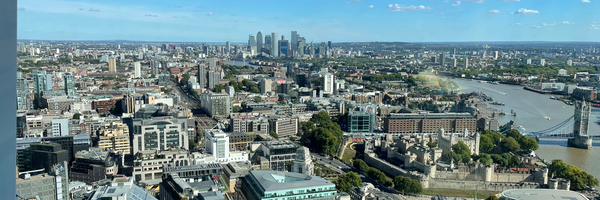
In August 2026, Europe endured its fifth heatwave of the summer. Temperatures climbed above 40°C across the continent for weeks at a stretch. France spent 52 days under official heatwave conditions — more than double the duration of the 2003 event that killed over 70,000 people and shocked the continent into action. Rivers dried. Crops failed. Governments urged citizens to stay indoors.
Three weeks later and seven thousand kilometres east, Nagoya recorded 104.5mm of rain in a single hour. It was the highest hourly rainfall in 136 years of measurement. Level 5 emergency orders — the highest possible — covered 1.17 million people across 14 wards. Forty-one were injured. The city, days away from hosting the Asian Games, began assessing venue damage before the water had finished rising.
Same planet. Same summer. Opposite catastrophes.
The instinct is to read both events through the same frame — climate change is getting worse, everywhere, all at once. That reading is accurate but incomplete. What this summer has actually revealed is something more structurally interesting: identical climate stress produces entirely different crises depending on the civilisational architecture underneath it. Europe and Asia are not failing in the same way. They are failing in the ways their histories made inevitable.
The City as Heat Trap
Europe's problem is not ignorance. The continent has known about heat risk since 2003. What followed that disaster was a genuine institutional response — France built its Plan National Canicule, a heat emergency system with mandatory cooling centres in every municipality, check-ins for isolated elderly residents, and a four-tier national alert. It worked, partially. Despite 2026 being thermally worse than 2003, France's death toll this summer ran roughly half of 2003's 15,000. Adaptation, when it happens, saves lives.
But France's partial success only sharpens the question of why the broader European response has stalled. The answer is not political will in the ordinary sense. It is something deeper: the built environment of European cities was designed for a climate that no longer exists, and changing it requires dismantling things that Europeans consider non-negotiable.
Medieval stone buildings retain winter heat by design. That same property turns them into ovens in a 40°C summer. Retrofitting them — insulating walls, installing cooling systems, modifying window configurations — runs directly into heritage preservation rules that govern much of historic Europe. A building in central Paris, Lyon, or Florence cannot simply be upgraded. The aesthetic and cultural identity of European cities, the very thing that makes them worth living in, is architecturally incompatible with the climate they now face.
And then there is air conditioning. In Asia, mechanical cooling is infrastructure — as unremarkable as running water, as culturally neutral as a light switch. In Europe, it carries a moral charge. Installing air conditioning is framed, in much public and policy discourse, as an act of environmental irresponsibility: it consumes energy, it externalises heat into the street, it is a symptom of the problem rather than a response to it. The result is that European cities in 2026 are asking populations to survive 40°C summers in buildings that were never designed for them, without the cooling technology that the rest of the world deploys as standard, because the ideology that explains the climate crisis has also placed the primary solution to one of its symptoms beyond easy reach.
Europe knows how to build. It has chosen, for reasons it considers virtuous, not to build these particular things.

The Limits of Engineering
Asia took a different path. It looked at its flood exposure — the typhoons, the monsoons, the river systems cutting through dense urban lowlands — and built accordingly. The results are genuinely extraordinary.
Beneath the northern outskirts of Tokyo sits the Metropolitan Area Outer Underground Discharge Channel, known as the G-Cans system: five cathedral-sized silos, each 65 metres tall, connected by 6.4 kilometres of tunnels buried 50 metres underground, feeding into a pressure tank the size of a sports stadium. Seventy-eight pumps, each powered by a Boeing 737-class jet engine, can discharge 200 cubic metres of water per second into the Edo River. It cost $2.6 billion and took 14 years to build. It is the most sophisticated urban flood infrastructure on earth.
It was not enough. When Nagoya recorded 104.5mm of rain in a single hour this September, the post-event assessment reached a precise conclusion: the flooding was not caused by infrastructure failure. The rainfall simply exceeded the system's design capacity. Japan's standard municipal stormwater infrastructure is engineered to handle approximately 50 to 60mm per hour. The storm delivered nearly double that. The infrastructure worked exactly as designed. The design envelope was wrong.
This is the asymmetry at the heart of Asia's flood problem. Europe's heat crisis is partly a failure of political will — the solutions exist and are being resisted. Asia's flood crisis is partly a failure of prediction — the infrastructure was built, and built well, for rainfall events that the climate has now reclassified as insufficient. Updating design standards requires not just money and time, which are finite, but the capacity to anticipate a future that keeps accelerating beyond projections.
In Hong Kong and mainland China, heat has largely been managed the way Asia manages practical problems: pragmatically, at scale, without ideological friction. Energy-efficient air conditioning is ubiquitous. The infrastructure for keeping people cool exists and works. But flooding and intensifying typhoons are now the frontier challenge — and here, as in Japan, the behavioural response is already running ahead of the policy response. People are quietly reassessing coastal and flood-prone property before the insurance market or government planning frameworks have updated their models. Prices in exposed areas are softening. Location decisions are shifting. Capital, as always, moves before policy does.
Who Gets Cooled
Cooling infrastructure has become one of the largest capital allocation decisions of the current decade — but not in the way most people are being cooled.
The global race to build AI data centres has created an industrial demand for cooling that dwarfs what most cities spend protecting their populations from heat. These facilities already consume roughly 40% of their energy on cooling systems under normal conditions. That share rises sharply during heatwaves — precisely when the power grids feeding them are simultaneously strained by millions of air conditioning units. Climate analytics firm First Street found that 79% of global data centre capacity now sits in regions facing elevated risk from severe weather. Asia-Pacific bears the heaviest burden: 89% of its data centre capacity is in acute risk zones.
The structural irony is not subtle. The resource being deployed at vast expense to keep servers cool is the same resource — energy, cooling technology, engineering capacity — that, allocated differently, could protect human populations from lethal heat. In countries where public cooling infrastructure is absent or inadequate, this is not an abstract observation. It is a question of who the infrastructure economy has decided to serve.
Singapore has attempted to hold both imperatives simultaneously, and its approach is instructive. It designated 2026 the Year of Climate Adaptation, producing a National Adaptation Plan that treats heat resilience, coastal and flood resilience, and water and food security as a single integrated challenge rather than separate portfolios. When it lifted its moratorium on new data centre construction, it did so with the strictest sustainability requirements in the Asia-Pacific region — 100% renewable energy, liquid cooling for at least 60% of IT load, mandatory waste heat recovery plans. It then quietly offshored its scale capacity problem across the Causeway into Johor, where Microsoft, NVIDIA, and AirTrunk are all building, creating a compute corridor that absorbs regional demand without concentrating energy and water stress inside a single city-state.
This is not just infrastructure strategy. It is climate strategy expressed through industrial policy — and it is a model almost no other city in the world is yet replicating.
The New Question
There is a standard framework for thinking about where to live, operate, or invest: assess the physical risk, review the insurance market, check the regulatory environment, consider the infrastructure quality. This framework was calibrated for a world where the climate was a background constant and the variables were political and economic. That calibration is now wrong.
The old question was: what is the climate like here? The new question is: how fast can this place adapt when the climate changes?
Physical exposure is largely fixed. A coastal city is a coastal city. What varies — what increasingly separates places that will remain viable from places that will not — is policy velocity: the institutional capacity to identify a new threat, build a coherent response, and execute it before the window closes. France's cooling centres demonstrate what adaptation looks like when it happens. Europe's air conditioning paralysis demonstrates what it looks like when culture resists it. Japan's G-Cans demonstrates what serious infrastructure investment produces. Nagoya's September flood demonstrates that even serious investment has a design horizon.
The decade ahead will sort cities, regions, and countries into two categories: those that are updating their models, and those that are still running on yesterday's weather. The gap between those two categories is already visible in property markets, insurance pricing, and the quiet location decisions of people who move before they have to.
Anyone optimising for the climate of 2010 — in site selection, supply chain routing, property acquisition, or infrastructure investment — is working from a map the territory has already left behind.
The Hub Lens 維點 is a newsletter for executives, investors, and entrepreneurs navigating business, wealth, and culture across Asia and beyond. The views expressed are analytical observations, not financial or legal advice.