The Market That Won't Die: Why the Nikkei at 60,000 Is a Policy, Not a Miracle
Japan's stock market keeps hitting all-time highs while its citizens struggle with rising prices, and its economy appears to be shrinking on the world stage. Korea is surging. Hong Kong is flat. None of this is random — it is a deliberate architecture. Here is what is really driving Asia's most important capital story.
The league table that lies
Japan is now the fourth largest economy in the world. It recently lost the third spot to Germany, and India is closing in fast. On the surface, this reads as a story of national decline — a once-dominant industrial power being overtaken by a resurgent Europe and a rising Asia.
Except the story is almost entirely wrong.
Germany did not build twice as many factories. India did not suddenly develop Japan's technological depth. What changed was a three-letter variable: JPY.
From 1995 to 2023, Japan's GDP fell from $5.5 trillion to $4.2 trillion in nominal US dollar terms. Not because Japan produced less. Not because its companies became less competitive. But because the yen weakened dramatically against the dollar, and nominal GDP rankings convert everything into USD at current market exchange rates. When the exchange rate moves, the ranking moves — automatically, mechanically — regardless of what is actually happening inside the economy.
Germany overtook Japan on the league table in 2023. But Germany was approximately half the size of Japan's economy a decade earlier in nominal dollar terms. No German economic miracle closed that gap. The yen did the accounting.
This distinction — between nominal GDP and real productive capacity — is the first thing you need to understand before any discussion of Japan's stock market makes sense. Because the same currency discount that makes Japan look smaller on the league table is precisely what makes its stock market an extraordinary opportunity for those who understand what they are actually buying.
Two ways to measure an economy — and why they tell completely different stories
Economists measure national output in two ways.
Nominal GDP converts a country's output into US dollars at current market exchange rates. It is simple, comparable, and deeply misleading when exchange rates are volatile. A weak currency mechanically shrinks a country's nominal GDP in dollar terms even if its real productive output is unchanged.
PPP GDP — Purchasing Power Parity — adjusts for what money actually buys domestically. It asks a different question: how much real stuff is Japan producing? Measured this way, Japan remains the fifth largest economy in the world, and the gap between Japan and its nominal rivals narrows considerably.
By 2024, Japan's real effective exchange rate — adjusted for trade flows and inflation differentials against its major trading partners — had fallen to its lowest level since the Bank of Japan began collecting statistics in January 1970. The yen, in real terms, lost roughly a third of its value against the basket of currencies it trades against. No war. No default. No economic collapse. Pure policy-driven depreciation.
Now apply that to the comparisons people make with Germany and the UK. The euro and the pound have both strengthened significantly against the yen. When Germany reports GDP in USD, its numbers translate upward. When Japan reports GDP in USD, its numbers translate downward. The ranking shift is substantially a measurement artefact, not a productive capacity story.
Japan still has 38 Fortune Global 500 companies. The fourth largest consumer market in the world. World-class manufacturing in robotics, semiconductors, precision equipment, and automotive. Decades of accumulated intellectual property and engineering depth. None of that disappeared. It simply got marked down in dollar terms — which, as we will see, is exactly what creates the opportunity.
A tale written in two Japans

Walk through any major Japanese city today and you will see two realities occupying the same space.
In one reality, the Nikkei 225 has just breached 60,000 for the first time in its history — a seven-decade milestone. Institutional portfolios are celebrating. Foreign investors are loading up. Corporate Japan is reporting some of its strongest earnings in a generation.
In the other reality, a bag of rice that cost ¥2,000 two years ago now costs nearly double. Ordinary households are quietly cutting back. Social media is full of complaints about overtourism — foreign visitors crowding train stations and bidding up restaurants — while locals can no longer afford those same restaurants themselves. Nominal wages are rising at a historic pace, but real wages have continued to contract as headline price increases outpace wage gains.
Both realities are real. And crucially, they are not in contradiction. One is the direct consequence of the other.
The correct framing is this: the Nikkei is not a thermometer of the Japanese economy. It is a thermometer of global capital's relationship with Japan Inc.
These are two completely different things. Japan Inc. — the export-driven corporate machine of Toyota, Sony, Fanuc, Advantest, SoftBank — earns its profits in dollars, euros, and yuan, then converts them back into a weakening yen. Every time the yen falls, those overseas profits multiply in local currency terms. The stock market rises. The salaryman's grocery bill rises too. The mechanism is identical; only the direction of the impact differs depending on which side of the transaction you are on.
The overtourism foreigners flooding Tokyo are not a cultural nuisance. They are a signal. Japan's assets — its restaurants, its hotels, its real estate, its equities — are priced at a significant discount in any non-yen currency. Foreign visitors are arbitraging that discount with their wallets. Foreign investors are doing the same with their portfolios.
Buying Japan at a three-layer discount
For foreign investors — and increasingly for Japanese citizens through the government's new investment incentive programme — Japan presents something rare: multiple independent discounts closing simultaneously.
The first layer is the currency discount. Japan's productive capacity has not shrunk. Its nominal GDP in USD has shrunk because the translation rate is punishing. The same factory, the same engineer, the same patent portfolio — all marked down 30% or more in dollar terms since 2020. You are buying real assets at a currency haircut. And since the Nikkei is denominated in yen, foreign investors converting from dollars, euros, or pounds are getting a further entry discount on top of any earnings growth.
The second layer is the valuation discount. Decades of deflationary psychology left Japanese companies trading below book value — meaning the market valued them at less than the liquidation value of their assets. In any Western market, this would be immediately exploited by activists. In Japan, it was the norm for thirty years. The Tokyo Stock Exchange reform launched in 2023, which publicly names and pressures companies trading below book value to present credible improvement plans, is forcing that discount to close. Nearly half of TOPIX constituents still trade below book. The re-rating has significant runway remaining.
The third layer is the governance discount. Pre-reform Japan featured entrenched management, cross-shareholdings that insulated executives from shareholder pressure, minimal buybacks, and near-zero dividend growth. That discount on how efficiently capital is deployed is also closing — accelerated by TSE reform, the arrival of Western activist investors, and a credibility signal provided by Warren Buffett's high-profile investments in Japan's major trading houses in 2020. When Buffett moves, global institutional capital pays attention.
Three discounts closing simultaneously, denominated in a currency that makes the entry price cheaper in your home currency. That is the structural bull case in one paragraph.
Why Asia? And why Japan and Korea?
Global institutional capital has been rotating into Asia. But it is not rotating equally. The divergence is stark and deliberate.
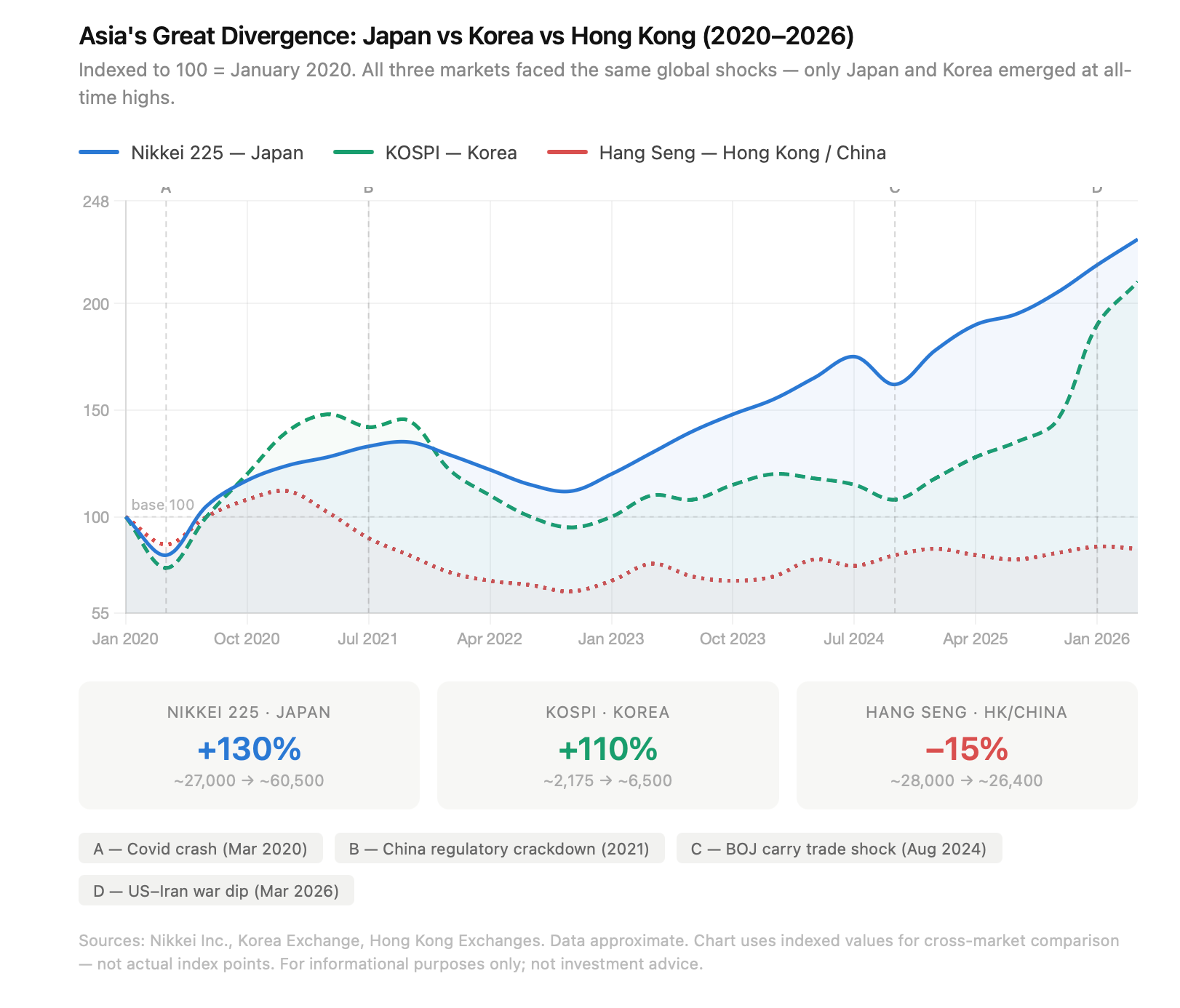
Japan is up roughly 130% from January 2020. Korea is up over 100%. The Hang Seng — representing Hong Kong and mainland Chinese equities — is down approximately 15% over the same period.
The reason is a political risk premium that no Western fund manager can fully model or hedge. China carries regulatory unpredictability, property sector instability, complex cross-strait economic dependencies, and capital control uncertainty. Even when Chinese fundamentals look attractive in isolation, the risk-adjusted case for large institutional allocations remains constrained. Hong Kong, once a structurally separate market, now carries enough of that premium to dampen foreign enthusiasm.
Japan and Korea carry no such premium. They are US security alliance members, and — critically — the physical infrastructure layer of the global AI buildout.
Every data centre constructed anywhere in the world — whether in Texas, the UAE, or Malaysia — requires memory chips from Korea and chip manufacturing equipment from Japan. The AI investment wave is not primarily a software story. It is a hardware supply chain story. Samsung and SK Hynix are the AI memory market. Advantest, Tokyo Electron, Lasertec, and Disco are the equipment market. Fanuc and Keyence are the factory automation market that builds the factories that build the chips.
Korea's Kospi surge is the most direct expression of this: semiconductor stocks led every major rally, with SK Hynix and Samsung driving outsized index moves on every positive AI demand signal from the United States.
Japan's version of the same trade is broader — spread across chip equipment, robotics, automation, and SoftBank's sprawling AI-linked technology portfolio — but the underlying driver is identical. Global capital is routing the AI infrastructure investment through Tokyo and Seoul because that is where the real supply chain lives.
China has its own AI ecosystem. Western funds are largely restricted from participating in it. The trade routes through Tokyo and Seoul by default.
The government machine: the weak yen and the bull market are the same policy
Here is what most financial commentary fails to state plainly.
Japan's weak yen is not a problem the government is trying to solve. It is a policy the government is administering. And the Nikkei bull run is not a separate phenomenon — it is the intended output of that same policy.
To understand why, you need to understand Japan's fiscal position. Japan carries the highest debt-to-GDP ratio of any developed nation, approaching 260%. The government cannot allow interest rates to rise aggressively, because the cost of servicing that debt at higher rates would be politically and fiscally catastrophic. So low rates — and therefore a structurally weak yen — are a near-permanent constraint, not a temporary condition.
Given that constraint is fixed, the optimal second-order move was to convert the weakness into a wealth transfer mechanism. The architecture works in five deliberate steps.
Step one: make cash toxic. Japanese households hold approximately ¥2,100 trillion — around $15 trillion — in assets, with roughly half sitting in cash and bank deposits. In a weak yen environment, holding yen cash is a guaranteed slow loss in real purchasing power. Every year of inaction costs you, visibly and measurably.
Step two: build the escape hatch. The government created NISA — the Nippon Individual Savings Account — and in January 2024 dramatically expanded it. Annual investment limits were doubled, the tax-exempt lifetime limit was raised to ¥18 million, and crucially, the tax-exemption period was made permanent and lifetime. The government set an explicit target of doubling total NISA assets within five years. The slogan "from savings to investments" had been Japanese government policy since 2001. The 2024 reform was the execution of a twenty-year strategic intent — and it worked. Mutual fund inflows nearly tripled in 2024 as retail investors responded.
Step three: force corporate compliance. The Tokyo Stock Exchange reform created the supply side of the equation. Companies trading below book value were publicly named and pressured to present credible improvement plans or face consequences including potential index removal. This forced buybacks, dividend increases, and portfolio restructuring across hundreds of Japanese corporates — creating the earnings quality improvement that justified a structural re-rating of the index.
Step four: signal the shift with credibility. Warren Buffett's investments in Japan's five major trading houses beginning in 2020 functioned as a public endorsement. When the world's most famous value investor declares Japan investable after decades of dismissal, global institutional capital follows. The signal mattered as much as the trade.
Step five: close the virtuous cycle. When citizens buy stock, rising markets generate wealth effects, consumer spending strengthens, corporate revenues grow, and the cycle reinforces itself. The government's explicit stated goal was to unlock precisely this virtuous cycle — converting Japan's vast dormant household savings into productive investment capital that generates returns for savers while simultaneously deepening equity market liquidity.
The result is a two-tier system. Citizens who hold yen cash are slowly penalised by the policy. Citizens who hold Japanese equities are buffered from yen weakness — because as the currency falls, the nominal value of their equity holdings rises. The NISA is Tokyo's formal invitation to switch sides.
This is why the Nikkei hitting all-time highs while ordinary Japanese people struggle with the cost of living is not a paradox. It is the mechanism working exactly as designed. The stock market is the hedge the government built. The only question is whether you are using it.
The one scenario that breaks the machine
The bull run has four independent engines running simultaneously: foreign AI capital routing through Tokyo, domestic NISA inflows, corporate governance reform unlocking dormant value, and BOJ policy suppression keeping rates and currency anchored. For all four to fail simultaneously is a low probability scenario.
But there is one scenario that unravels the entire architecture: a forced, rapid Bank of Japan rate normalisation.
If inflation becomes uncontrollable and the BOJ must hike aggressively to defend the yen and contain prices, three things happen at once. The yen carry trade — global investors borrowing cheap yen to buy higher-yielding assets elsewhere — unwinds violently, triggering equity liquidation. The government's debt servicing cost explodes as rates rise against a ¥260 trillion debt burden. And the export earnings premium that has been driving corporate profits evaporates as the strengthening yen compresses overseas earnings on repatriation.
We have already seen this stress-tested once. In August 2024, a single BOJ rate signal triggered one of the fastest equity corrections in modern market history — the Nikkei fell nearly 20% in days, surpassing 1987's Black Monday as the largest single-day point drop in the index's history. The recovery was equally dramatic. Within weeks the market had reclaimed its losses and continued to new highs. The stress test was passed. The floor was raised.
The government will resist aggressive rate normalisation as long as politically possible, because the fiscal consequences of rapid rate rises are severe. The BOJ and the government are in a codependent constraint that, paradoxically, protects the equity bull run. Gradual is the only gear available. And gradual means the current architecture persists far longer than bears anticipate.
For the investor: three things to understand
First, the Nikkei at 60,000 in yen is not as expensive as it looks. Measured in dollars, euros, or pounds, you are buying one of the world's most sophisticated industrial and technology economies at a meaningful currency discount. The headline number is denominated in a devalued unit.
Second, riding with the Japanese government's policy direction is not speculation — it is alignment with sovereign intent. The BOJ, the TSE, the FSA, and the Ministry of Finance are all pointed in the same direction. When four institutional forces align simultaneously, the rational posture is not to look for reasons to be bearish. It is to ride the current until one of those forces clearly breaks.
Third, the same logic that makes Japan compelling makes Korea a parallel but distinct play. Japan is the broader infrastructure and industrial exposure — wide, deep, and policy-supported. Korea is the more concentrated, higher-volatility AI memory bet. Japan for structural conviction. Korea for those willing to run a sharper semiconductor cycle trade.
The closing reframe
Japan's nominal GDP ranking fell because its currency fell — not because its economy weakened. The same discount that makes Japan look smaller on the league table makes its stock market cheaper to own. The Nikkei at 60,000 in yen is not a bubble. In dollars, euros, or pounds, you are still buying one of the world's most sophisticated economies at a significant markdown — and the Japanese government has designed the entire system to ensure that markdown closes over time.
The GDP ranking tells you what the yen is worth against the dollar. The Nikkei tells you what Japan Inc. is worth to the world. These are different questions. Confusing them is the most common mistake in reading Japan's economic story.
The bull market's escape hatch was always open. The Japanese government has been signalling which door it is for years. The only question is whether you walked through it.
This article is for informational and analytical purposes only and does not constitute financial or investment advice.