The Other Balance Sheet: What France’s Bond Market Isn’t Pricing
France's bond yields are the headline, but a quieter shift in what the world wants to drink and wear is thinning the cushion beneath them. A view from the tasting room on how fast demand, and whole industries, can change.

While investors watch French yields, a quieter shift in what the world wants to buy is changing the country’s story, and it is a warning for every business.
The bond market's story
Last week France's ten-year borrowing cost briefly topped 5%, its highest level since 2002, and the government announced it will borrow a record €340 billion next year. Public debt stood at 117.6% of GDP in the first quarter of 2026, and the 2026 deficit is expected to widen to 5.4%. The financial press has its diagnosis, and it is a fair one: this is a spending and debt problem.
But it is not the only problem. While investors watch yields and spreads, some of the pillars that once cushioned France's position are thinning at the same time, and I have watched that happen from the inside.
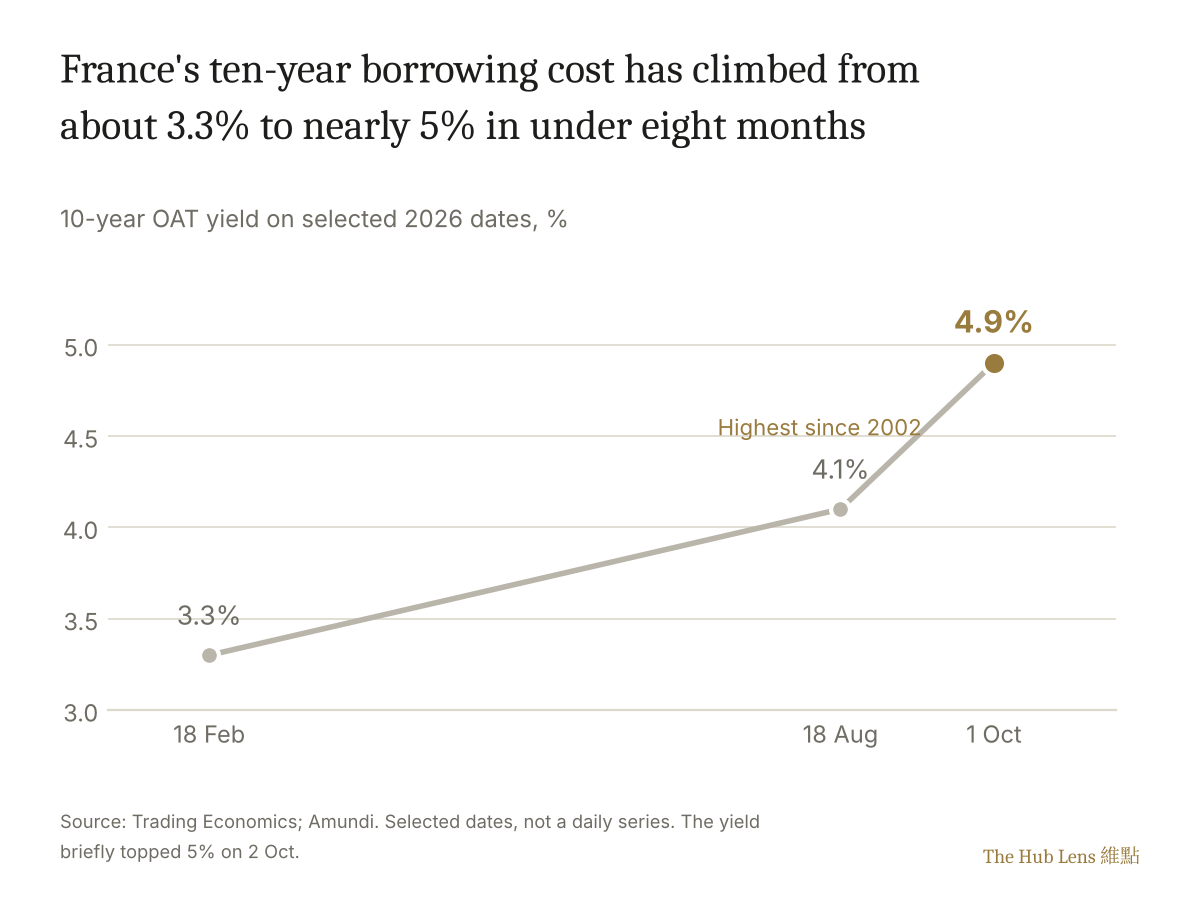
France's ten-year government bond yield rose from 3.3% on 18 February 2026 to 4.1% on 18 August and 4.9% on 1 October, the highest since 2002
The view from the tasting room
A decade ago I spent my evenings in wine classes, learning the limestone of Saint-Émilion and the granite of the Northern Rhône. I also worked with independent growers from France and elsewhere in Europe who were trying to break into Asia. In Hong Kong, Japan and mainland China, the playbook was simple. The word "Bordeaux" or "burgundy" did most of the selling. Importers chased allocations, and a classified growth on the table signalled that you had arrived.
That world has changed, and the data now says so. Global wine consumption fell to 208 million hectolitres in 2025, the lowest since 1957 and roughly 14% below 2018. France's own consumption slipped 3% to 22 million hectolitres. In China, import volumes fell 26.7% in 2025 to 207 million litres, against more than 612 million litres in 2019. French shipments there dropped 36.1% in volume.
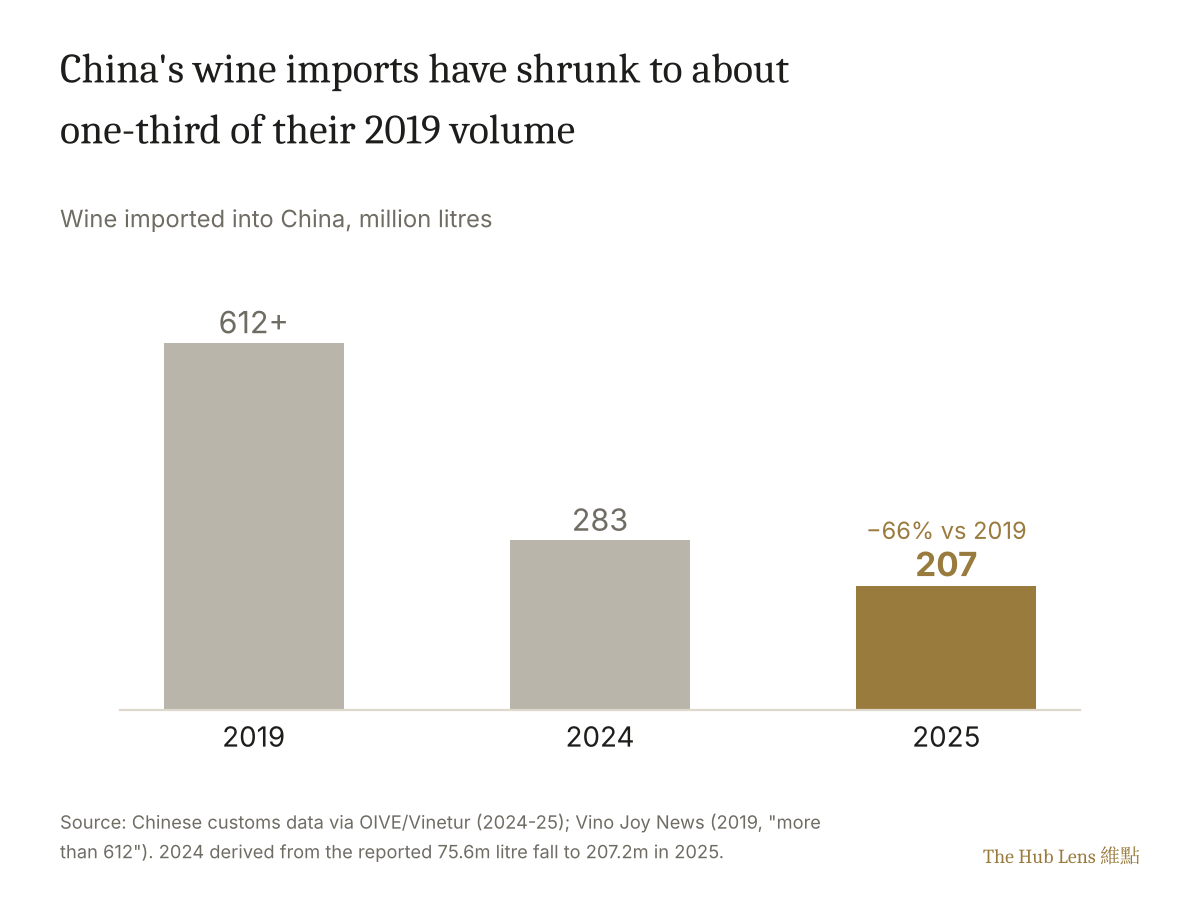
China's wine imports fell from more than 612 million litres in 2019 to about 283 million in 2024 and 207 million in 2025, down 66%
The shift is not a collapse of appetite so much as a change in taste. In China, sparkling wine was the only category to grow in both volume and value, and whites gained ground. In the first quarter of 2026, French wine rose 8.9% in value even as volume fell 5.2%. Fewer bottles, higher prices, lighter styles, less ceremony. A heavy tannic red that needs a cellar and an hour of decanting suits a generation raised on spritzes and wellness apps less than it suited their parents.
Same pattern, different glass
The same pattern shows up in sake, which makes it a story about Asian consumers and not only about France. Sake's share of Japan's alcohol market has fallen from over 70% after the war to about 5% in 2024, and the number of breweries from roughly 30,000 at the end of the nineteenth century to about 1,300 today.
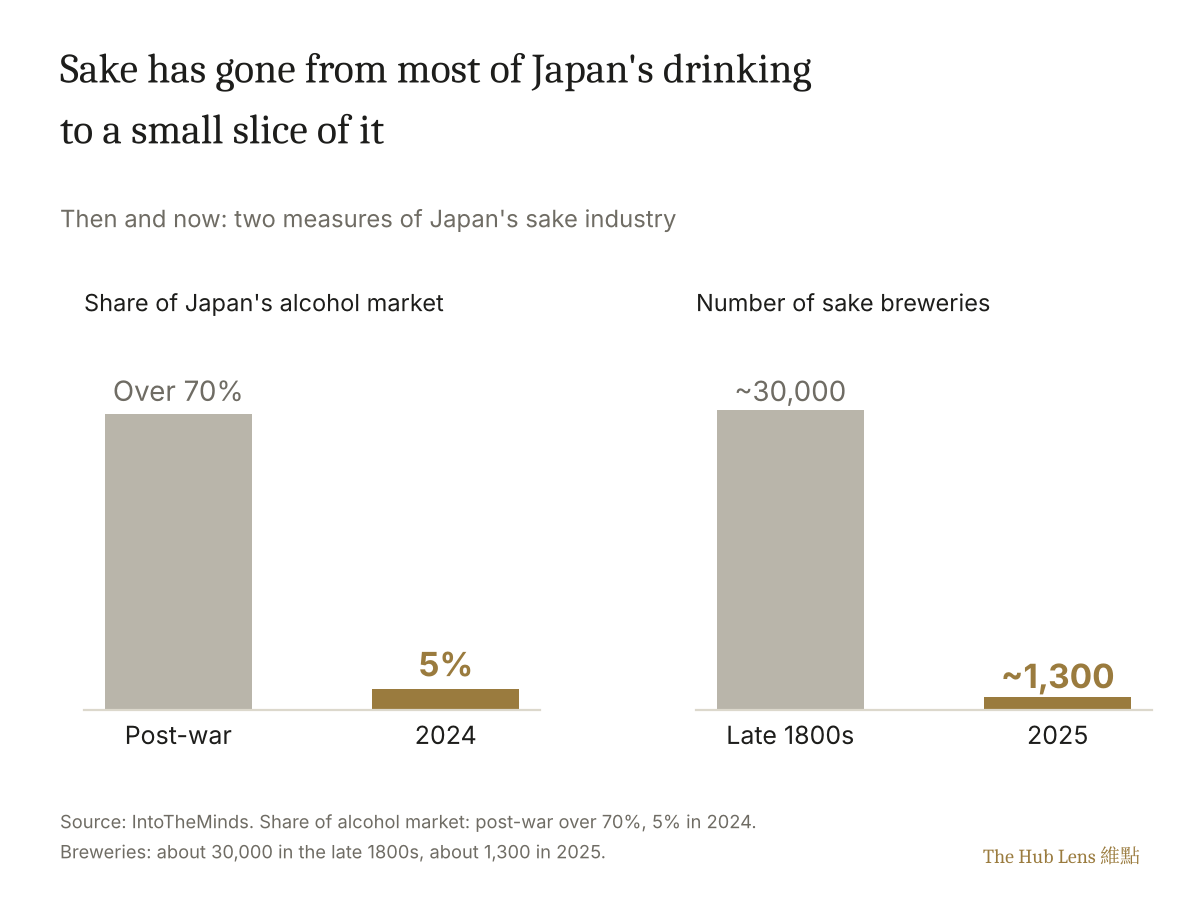
Two bar charts: sake's share of Japan's alcohol market fell from over 70% post-war to 5% in 2024, and sake breweries fell from about 30,000 in the late 1800s to about 1,300 in 2025
Inside Japan, one survey found nearly 44% of people in their twenties never drink alcohol, and national tax data show alcohol sales peaked in 1996 and have declined steadily since. Asahi has said that alcohol-free beer is about 10% of its beverage sales in Japan. Brewers are answering with low-alcohol and sparkling sake, and restaurants are pushing "Sake-High", sake mixed with soda water. Demand is moving between categories as much as it is disappearing: the OIV reports that wine consumption in Japan rose 6.8% in 2025, against the global trend.
Beyond wine: luxury and watches
On the ground in France, the adjustment is already visible. The government has announced a €130 million uprooting fund for 2026 and 2027, paying €4,000 per hectare and potentially €10,000 in the most vulnerable zones. In Gironde, the department around Bordeaux, vineyard area fell by 20,000 hectares between 2023 and 2025. A region built on the assumption of ever-growing demand is now being paid to shrink.
Luxury tells a similar story, and not only a French one. Bain estimates the personal luxury market dipped 2% to €358 billion in 2025, with aspirational shoppers pulling back while the ultra-wealthy kept spending. Swiss watches show it clearly. Exports fell 1.7% to CHF 25.6 billion in 2025, a second straight year of decline, and sales in China contracted by more than a third over two years. In the first half of 2026 the industry federation described a more stable Greater China after a 30% drop over two years. Categories that felt permanent turned out to depend on one cohort, in a few markets, at one moment.
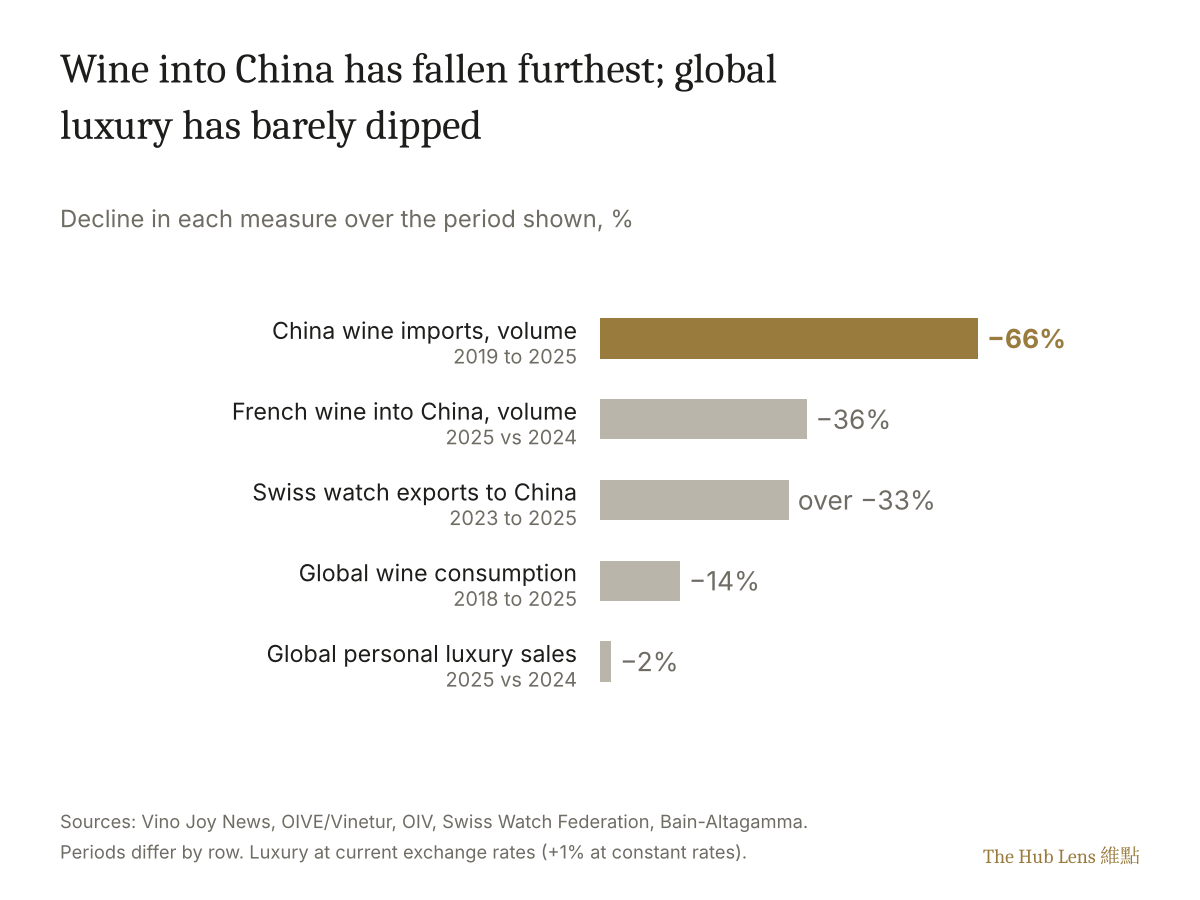
Horizontal bar chart of declines: China wine imports down 66% from 2019 to 2025, French wine into China down 36%, Swiss watch exports to China down over 33%, global wine consumption down 14%, global personal luxury sales down 2%
The lesson for business
Wine, luxury and cars did not pay for the French welfare state, and the debt problem is mainly about how France spends. My point is narrower. These industries were a cushion of export income and prestige, and the cushion is thinning just as the bond market has become less forgiving. A country has less room for error when its flagship products stop being automatic purchases.
For anyone running a business across Asia and Europe, the practical lesson is uncomfortable. The shifts that matter rarely announce themselves in the quarterly numbers. They appear first in who fills the tasting room, what younger colleagues order at dinner, and which categories your best importers quietly stop pushing. By the time they reach the income statement, the adjustment is already expensive. The question to ask is not whether your category is strong today, but who is buying it in ten years, and whether they want the product or the ritual that came with it.
This article is for general information and discussion only and does not constitute financial, investment or legal advice.