When Hong Kong's Superman Folds His Cards
Li Ka-shing has sold Hong Kong, China, global ports, and now all of Europe. Reading the full ledger tells you something the headlines don't — and it changes how you should think about where capital is heading next.
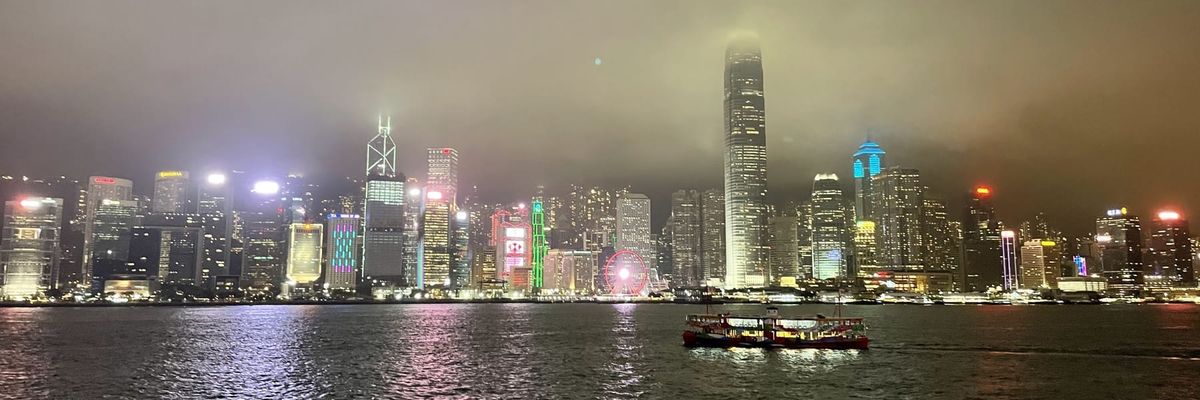
Reading Li Ka-shing's fifty-year ledger — and what it tells you about where capital is actually heading next.
The most accurate map of where global capital is heading is not in any investment bank report. It is not in the IMF's Article IV consultations or the World Economic Forum's annual outlook. It is in the transaction history of one Hong Kong family — compiled quietly across five decades, on four continents, almost always a beat ahead of where the consensus eventually arrives.
Li Ka-shing — dubbed Superman by the Hong Kong press for his near-supernatural instinct for timing — built one of the most diversified conglomerates in modern history out of a plastics factory in 1950. By the time he handed the chairmanship to his son Victor in 2018, his companies owned ports, supermarkets, telecoms operators, power grids, train-leasing businesses, drugstore chains, and real estate portfolios stretching from the South China Sea to the Scottish Highlands. More than the scale, what defines the CK group's record is the pattern of entry and exit: buy what others have abandoned, hold until peak, sell before the turn, build cash, repeat.
Right now, the sell cycle is running at pace — and across a striking range of asset classes and geographies. The UK exits alone have generated over £15 billion in cash in roughly eighteen months. The question most coverage asks is what they sold. The more interesting question is what comes next.
The pattern, read in full
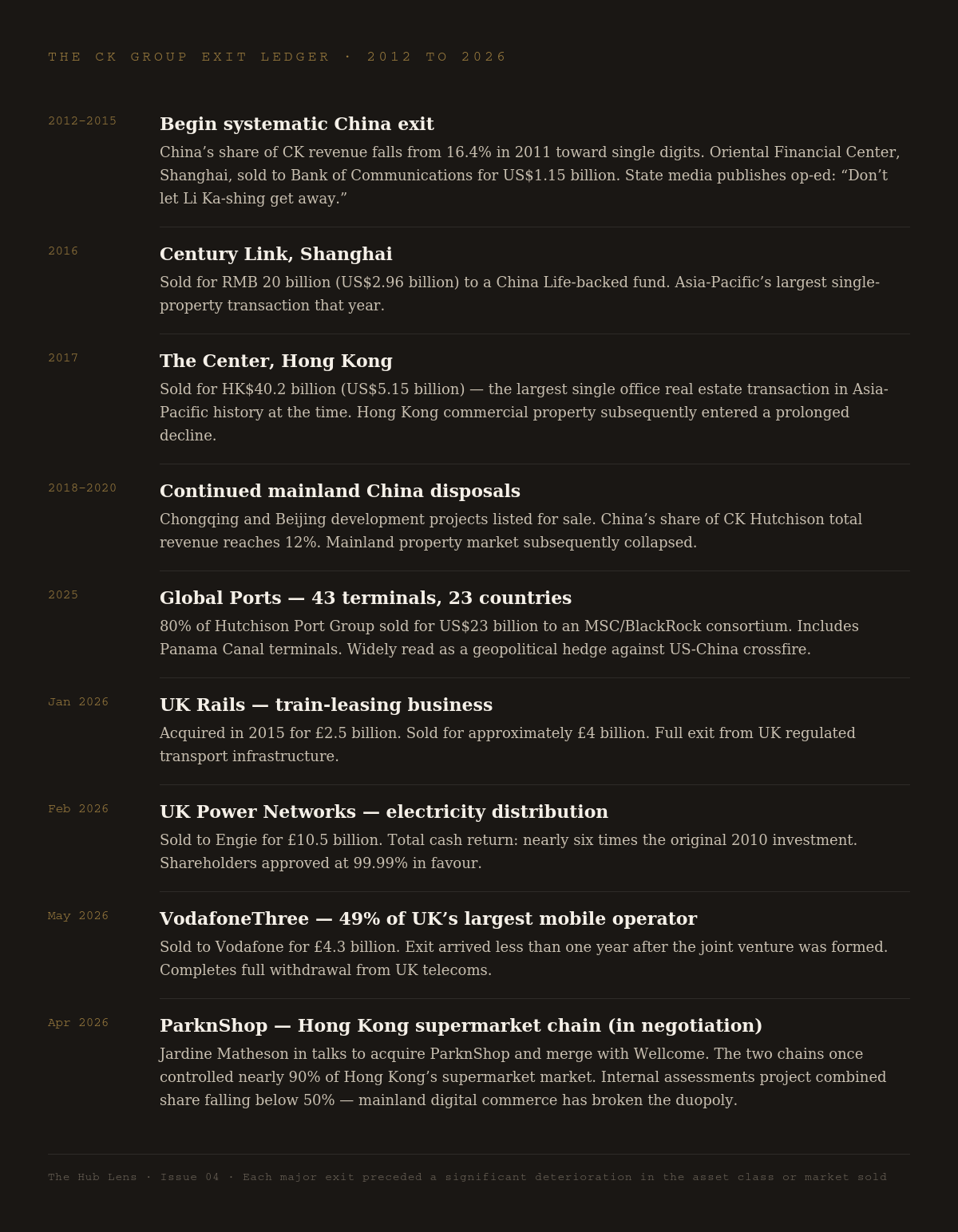
The pattern, viewed in sequence, is more striking than any single deal suggests. The Hong Kong and China exits began not in 2017 but closer to 2012 — methodically, quietly, over nearly a decade. The flagship sales were the visible tip of a much longer rotation. And in each case, what followed the exit was a sustained decline in the asset class that had been sold. Hong Kong commercial real estate fell sharply after 2018. Mainland China's property sector collapsed into one of the deepest corrections in its history. The European infrastructure positions accumulated during the era of near-zero interest rates are being liquidated now, as higher rates compress those returns and political scrutiny of foreign ownership of critical national infrastructure has risen sharply across the UK and Europe.
Read the ledger in full and a discipline emerges that is unmistakeable. This is not reactive portfolio management — it is a systematic practice of identifying where the risk-return has structurally peaked, crystallising the gain at maximum valuation, and building dry powder for what comes next.
The assets offload — earlier than anyone reported
The commonly told story begins in 2017, with the sale of The Center. However, the fuller story begins around 2012. China's share of CK revenue fell from 16.4% in 2011 toward single digits. The property disposals accumulated: the Oriental Financial Center in Shanghai, then the Century Link complex, then The Center in Hong Kong, then a string of mainland development projects in Chongqing and Beijing. In 2015, Chinese state media published an op-ed with the headline "Don't let Li Ka-shing get away" — essentially accusing him of disloyalty for redirecting capital out of the mainland. He kept going with his business instinct.
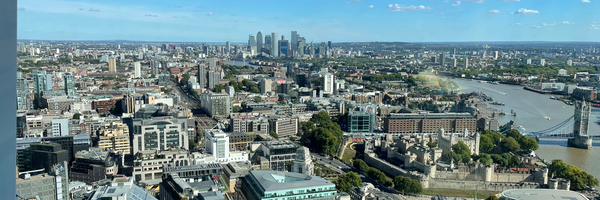
What matters about this timeline is not the political subtext, which is easy to over-read, but the capital logic. The early China exit was a recognition that the risk-return profile of Chinese property and infrastructure had peaked relative to what was available elsewhere, at a moment when most Western investors were still crowding in. The proceeds went into UK power grids, train-leasing businesses, and telecoms assets — regulated returns undervalued in a world of abundant capital and policy certainty, in jurisdictions that institutional investors trusted. That trade ran for roughly a decade. By 2026, it was also done.
The UK exit — a different logic
The European infrastructure exits of 2025 and 2026 are a different kind of move — not a geopolitical hedge but a return calculation.
The UK regulated asset model made obvious sense in the environment in which CK built its positions: near-zero interest rates, political stability, a clear regulatory framework that guaranteed returns over long asset lives, and foreign ownership of critical infrastructure that nobody in Whitehall particularly wanted to question. UK Power Networks, UK Rails, Three UK — all fit the same template. Buy, hold, collect. The family generated extraordinary returns: the Power Networks exit alone returned nearly six times the original 2010 investment.
What changed is the arithmetic. Higher rates have raised the opportunity cost of holding long-duration regulated assets. Political risk around foreign — particularly Asian — ownership of British critical infrastructure has risen steadily since the early 2020s, adding a layer of regulatory unpredictability that compressed the effective return. And CK's position as a Hong Kong conglomerate with complex mainland associations made it an increasingly visible target in a UK that had grown more attentive to national security considerations. When CK's co-managing director described the rationale simply as "cash is king," it was accurate and incomplete in equal measure. The fuller version: cash is king when you have already made your money and the next rotation has not yet become obvious.
The ParknShop signal
Before turning to where the capital might go, the ParknShop negotiation deserves its own reading — because it carries a different signal from the UK exits.
The UK divestments are about extracting peak value from assets where conditions have structurally shifted. The ParknShop move is about something more fundamental: the permanent transformation of Hong Kong's consumer economy from within. ParknShop and Wellcome together controlled nearly 90% of Hong Kong's supermarket market as recently as 2023. That dominance, in a dense, high-footfall urban environment with significant barriers to new physical retail entry, looked like a permanent competitive moat. Internal assessments now project the merged entity's market share falling below 50%. That is not a cyclical correction. That is a structural break.
Its source is the accelerating integration of mainland Chinese e-commerce into everyday Hong Kong consumer behaviour. Alibaba's fresh-food platforms and a growing network of cross-border delivery services have effectively dissolved what was once a meaningful logistics boundary for ordinary grocery purchasing. Price points and selection breadth that a traditional supermarket network cannot match are now available to any Hong Kong household with a smartphone. For the executive or investor reading Hong Kong, this is not a story about the city's decline. It is a story about the velocity and depth of its integration with the mainland economy — and the sophistication required to distinguish between the businesses that will survive that integration and those that will not. The supermarket chains are in the second category. Hong Kong's financial infrastructure, its legal system, its IPO pipeline, its family office ecosystem — those are emphatically in the first.
"The people who declared Hong Kong finished have mostly never had to move money across the Pacific in size. The infrastructure didn't close. The narrative did."
Two Hong Kongs — and the mistake of conflating them
There is a version of Hong Kong that appears regularly in Western media, on emigrant forums, on the threads and Reddit communities of those who left after 2020. It is a city of anxiety and loss — press freedom constrained, familiar faces gone, the particular atmosphere of a place that once felt like the most energized city on earth now subdued and watchful. That experience is real. The people who describe it are not wrong about what they went through, and it would be both inaccurate and unkind to dismiss it.
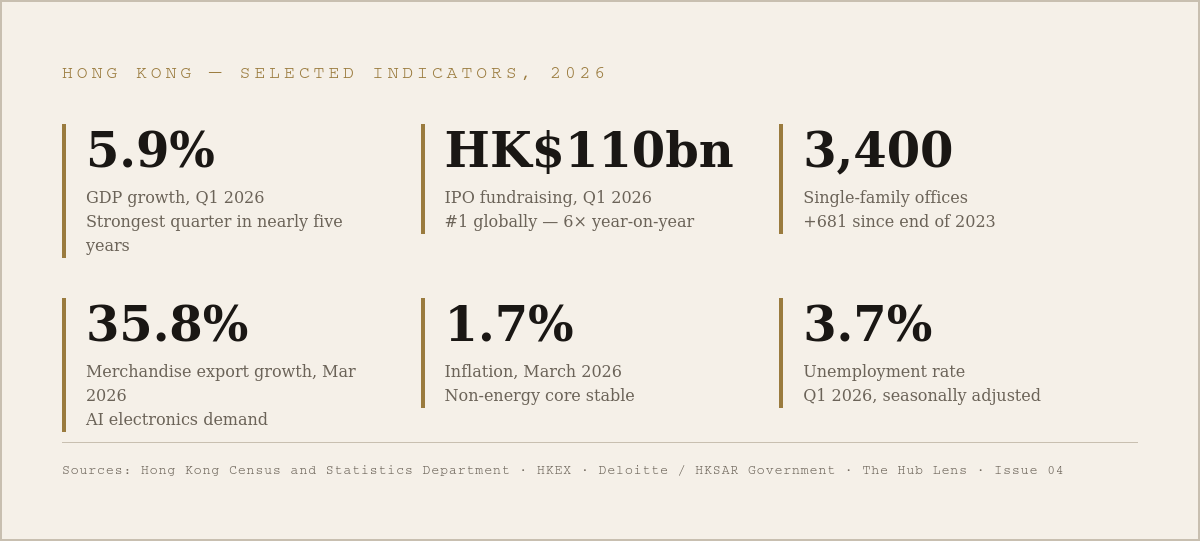
And then there is the version of Hong Kong that the numbers describe in 2026. Real GDP grew 5.9% in the first quarter — the strongest quarterly expansion in nearly five years. The Hong Kong Stock Exchange topped all global IPO venues in that same quarter, with 40 listings raising HK$110.4 billion, a near-sixfold increase on the year before. Unemployment sits at 3.7%. Inflation is contained at 1.7%. The city hosts nearly 3,400 single-family offices, up by 681 in two years. Merchandise exports grew 35.8% year-on-year in March, driven by strong global demand for AI-related electronics flowing through Hong Kong's trade infrastructure.
Both versions are real. The mistake — one that costs people genuine strategic clarity and, in some cases, genuine money — is treating them as the same story. One is a political and cultural narrative about a society that went through a wrenching change of political settlement. The other is a capital flow report. They can run in opposite directions simultaneously, and right now they are running in opposite directions with considerable force.
What has changed is the political environment. What it did not change is the port, the currency peg, the common law framework for commercial contracts, the tax structure — corporate tax capped at 16.5%, zero capital gains, zero dividend tax — the geographic position between mainland China and the Pacific, or the density of financial and professional infrastructure that took a century to build. A legal system that Western and Asian counterparties both understand and trust cannot be assembled quickly. Financial depth — the relationships, the institutional knowledge, the clearing infrastructure, the talent concentration — takes generations. Hong Kong built all of that. It remains intact.
The Dubai equation — a new inbound flow
One development that has received almost no coverage in the context of Hong Kong's current economic story is the recalibration of what had become a one-directional Middle East wealth corridor.
For several years, the flow had been outbound: Hong Kong families, Chinese UHNWIs, and globally mobile capital moving toward Dubai, drawn by the UAE's tax neutrality, its deliberate positioning outside the US-China competition, and the speed with which it had assembled world-class financial infrastructure. Dubai became, for a period, the closest available analogue to what Hong Kong had been — clear rules, excellent infrastructure, political risk that felt comfortably distant, and a cosmopolitan professional community that could service complex cross-border structures. For many of the executives and families who had left Hong Kong after 2020, it provided something that felt familiar.
The Iran war in early 2026 changed that calculus sharply. When the conflict closed the Strait of Hormuz and brought military action across the wider region, Dubai's positioning as a neutral safe haven absorbed a direct hit. The question that ultra-high-net-worth individuals and family offices ask when choosing a domicile is not primarily about tax rates — those can be replicated — but about whether the threat environment is manageable. Hong Kong's response was not accidental. The government had already expanded its family office tax exemption framework, adding gold and cryptocurrencies to the exemption list, going further than equivalent Singapore legislation, and updated the investment migration scheme in March 2026 to give greater flexibility in how qualifying capital is held. The result, according to fund formation lawyers operating in the city, was a surge in inbound interest in early 2026 that caught even optimistic observers off guard. Nearly 3,400 single-family offices now operate in Hong Kong, up 681 from the end of 2023. The Middle East instability accelerated an upward trend that was already well established.
Where the cash is going - A new direction?
Return to the war chest. The UK exits alone have generated over £15 billion in cash across roughly eighteen months. Add the port sale proceeds. The group is sitting on a level of liquidity that demands deployment, and wherever that deployment lands will be read by sophisticated observers as a forward-looking bet on where the next cycle favours long-duration capital.
The family's historical logic is consistent enough to project with some confidence. They buy where they see structural undervaluation against a clear long-term demand driver. They avoid markets where the political environment makes asset ownership uncertain or where the regulatory landscape has become unpredictably hostile. They prefer positions where scale gives them some ability to set terms. Southeast Asia infrastructure fits that template — the AI infrastructure buildout across the region represents exactly the kind of long-duration, regulated-return asset class the group understands and has the balance sheet to underwrite at scale. Hong Kong real estate itself, having corrected significantly from its 2019 peaks, may now be back within range of their entry criteria. The family that built its fortune buying Hong Kong property when everyone else was fleeing in 1967 would not be above doing something analogous in 2026.
What the war chest almost certainly will not redeploy into is European regulated infrastructure on current terms, or any market where foreign Asian ownership of critical assets has become a structural political liability. The lesson of the UK exits is not that the trade was wrong — the returns over two decades were extraordinary. The lesson is that the entry conditions that justified it no longer exist, and the CK group's history suggests they recognised that before the market did. They nearly always do.
What this means for the room this newsletter is written for
The Li Ka-shing ledger is not reading material for those who want to admire a billionaire's track record from a comfortable distance. It is a navigational instrument — one of the few available that has been calibrated and tested across multiple full economic cycles, on multiple continents, in market environments ranging from Hong Kong's post-war reconstruction to the zero-rate era to the current multipolar disorder.
For executives restructuring supply chains or considering where to anchor their Asia operations, the CK group's systematic conviction that Asia-facing positions now offer superior risk-return relative to European ones is worth weighing seriously. For investors carrying European infrastructure exposure, the timing and scale of these exits should prompt a direct review of whether the structural thesis still holds. For family offices considering jurisdictional diversification, the combination of Hong Kong's improving tax framework, its undiminished institutional depth, and the new inflow of Middle Eastern capital tells you something concrete about where sophisticated money is moving — and why. And for those who have been reading Hong Kong's political changes as evidence of economic decline, the ledger offers a useful corrective: Superman sold Hong Kong at the top in 2017. He sold China at the top. He is selling Europe now. He has not, as yet, sold Hong Kong's financial infrastructure. That, too, is information.
Bowen is an independent business consultant and cross-cultural strategist. He has lived and worked across Hong Kong, Singapore, Kuala Lumpur, Tokyo, London, Lille and Stockholm. This article is for informational and analytical purposes only and does not constitute financial or investment advice. Nothing in this newsletter should be construed as a recommendation to buy, sell, or hold any asset or security.